It was always about whether anyone would pay for it
For the last two years, most of the AI industry has been obsessed with one thing.
Models.
Benchmarks.
Who is ahead.
But quietly, the market has been answering a different question.
Does this actually make money for someone?
That question decides which technologies survive.
Not press coverage.
Not funding rounds.
Not demos.
Revenue.
And this is where the AI conversation is starting to change.
Why so many powerful AI systems are struggling
There is a strange contradiction in the AI boom.
We have systems that can write, reason, see, speak, and generate almost anything.
Yet most companies still do not know how to turn that into reliable business value.
That is not a model problem.
It is an interface and workflow problem.
As Harvard Business Review has repeatedly documented, most AI initiatives fail not because the technology is weak, but because it is not embedded into how work actually happens.
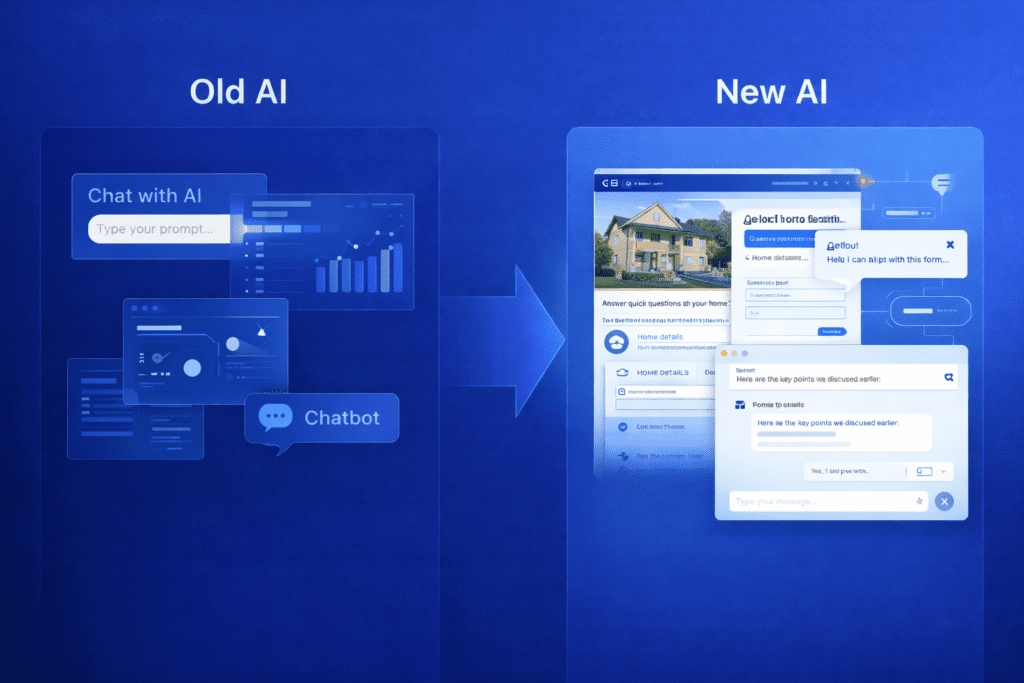
Most AI still lives in places people have to remember to visit.
A chat window.
A dashboard.
A prompt box.
But customers do not live there.
They live on websites.
In inboxes.
On landing pages.
Inside moments where they are ready to buy, ask, decide, or leave.
If AI does not exist inside those moments, it never touches revenue.
It stays impressive but economically invisible.
Why monetization is the real AI frontier
The industry is slowly running into something uncomfortable.
The hardest part of AI is not making it smart.
The hardest part is making it useful inside real businesses.
That means:
Showing up when a customer is actually there
Answering the question that blocks a purchase
Capturing intent before it disappears
Moving someone forward instead of making them wait
This is not theoretical.
According to Salesforce and its State of the Connected Customer research, modern customers now expect companies to respond immediately and will leave when they do not.
Speed is not a feature anymore.
It is the product.
What actually makes AI valuable
Strip away the hype and AI only creates value when three things happen.
It shows up at the right moment
It responds immediately
It moves the interaction forward
That is it.
Not personality.
Not creativity.
Not even raw accuracy.
This is why HubSpot found that responding to a lead within minutes massively increases the likelihood of conversion, while delays cause intent to evaporate.
A perfect answer that arrives late is worth nothing.
A good answer that arrives instantly changes outcomes.
This is why response time has become one of the most important metrics of the AI era.

The scoreboard is changing
The AI race is no longer about who has the biggest model.
It is about who can turn intelligence into outcomes.
Leads.
Conversions.
Booked meetings.
Completed forms.
Decisions made.
We are entering the phase where intelligence is no longer something you open.
It is something that simply exists inside the flow of real life, what one recent piece described as when intelligence became part of the environment.
The companies that win will not be the ones with the most parameters.
They will be the ones whose AI lives inside the moments where real people are actually deciding what to do next.
That is where AI stops being impressive.
And starts being real.