The Critical Conversion Window
Traffic is measurable.
Ad spend is measurable.
Clicks are measurable.
What happens after the click determines whether website traffic turns into sales.
When a visitor lands on your site, intent is at its highest point. They searched. They clicked. They arrived with a reason.
The window to act on that intent is small.
Two variables consistently determine whether that visit becomes a qualified lead:
Faster lead response.
Relevant personalization.
Why Faster Lead Response Increases Conversions
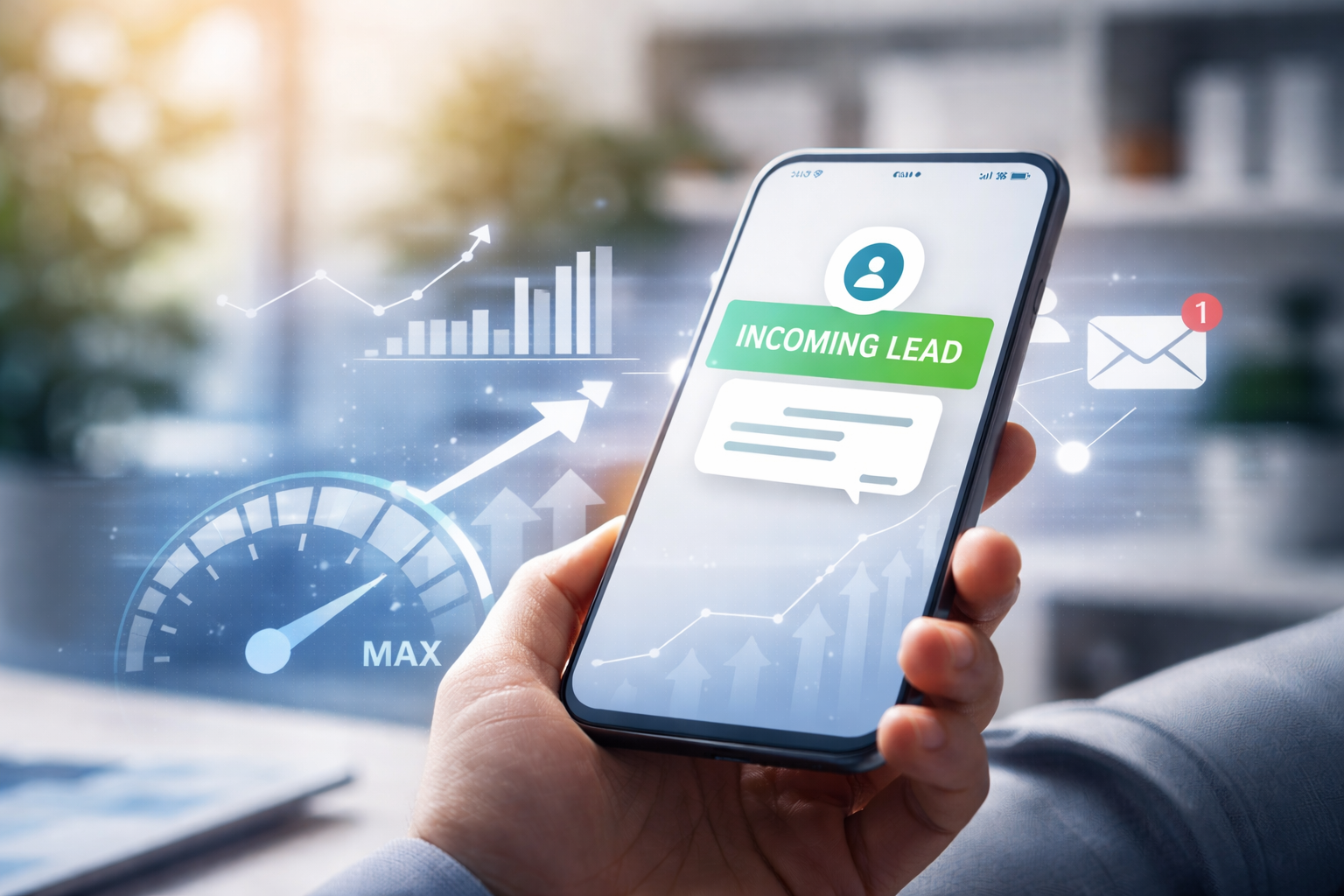
Lead response time has a direct impact on conversion rates.
Research published by HubSpot found that companies responding to a lead within 5 MINUTES are 21X more likely to qualify that lead than those who wait thirty minutes or longer.
TWENTY ONE TIMES.
That difference is not incremental. It materially changes sales outcomes.
A slow lead response introduces friction.
Friction reduces momentum.
Reduced momentum lowers conversion probability.
When someone submits a form or begins searching for answers, they are evaluating not only your offer, but your responsiveness.
Silence signals delay.
Delay weakens buying intent.
Faster lead response protects that momentum and increases the likelihood of higher conversions.
The Revenue Impact of Personalization
Speed alone does not maximize sales conversion.
Research from McKinsey shows that companies leading in personalization generate 40% MORE revenue from those efforts than average performers.
Personalization directly affects conversion rate performance.
Personalization is not inserting a name into an email.
It is delivering context based on behavior and intent.
If a visitor is reviewing pricing, the conversation should reflect pricing intent.
If they are comparing features, the response should guide feature clarity.
When faster lead response is paired with relevant personalization, conversion efficiency improves significantly.
Relevance compounds speed.
How Website Lead Conversion Breaks Down
Many websites unintentionally slow down lead response time.
Forms route to inboxes.
Emails wait for review.
Calls require scheduling.
By the time a sales representative engages, initial urgency has cooled.
Intent has a half life.
The longer the gap between inquiry and response, the lower the probability of sales conversion.
This is not simply a staffing issue.
It is a lead response timing issue.
Using AI to Improve Lead Response Time
An AI Sales Agent improves lead response speed without sacrificing personalization.
It engages website visitors instantly.
It responds based on context.
It qualifies leads in real time.
It hands off to human sales teams when appropriate.
Not as a chatbot.
Not as a scripted flow.
But as a trained sales layer embedded directly into the website experience.
Faster lead response improves qualification rates.
Personalized engagement increases revenue per lead.
Together, they produce higher conversions.
The Strategic Shift
Attracting traffic is only the first step.
Protecting the moment after the click is what drives revenue growth.
Faster lead response increases conversions.
Personalization increases revenue per conversion.
Higher conversions are not driven by more traffic alone.
They are driven by reducing response time and increasing relevance.
Because growth does not break at the ad.
It breaks after the click.